A 20-Minute Sunday Reset for a Small Home
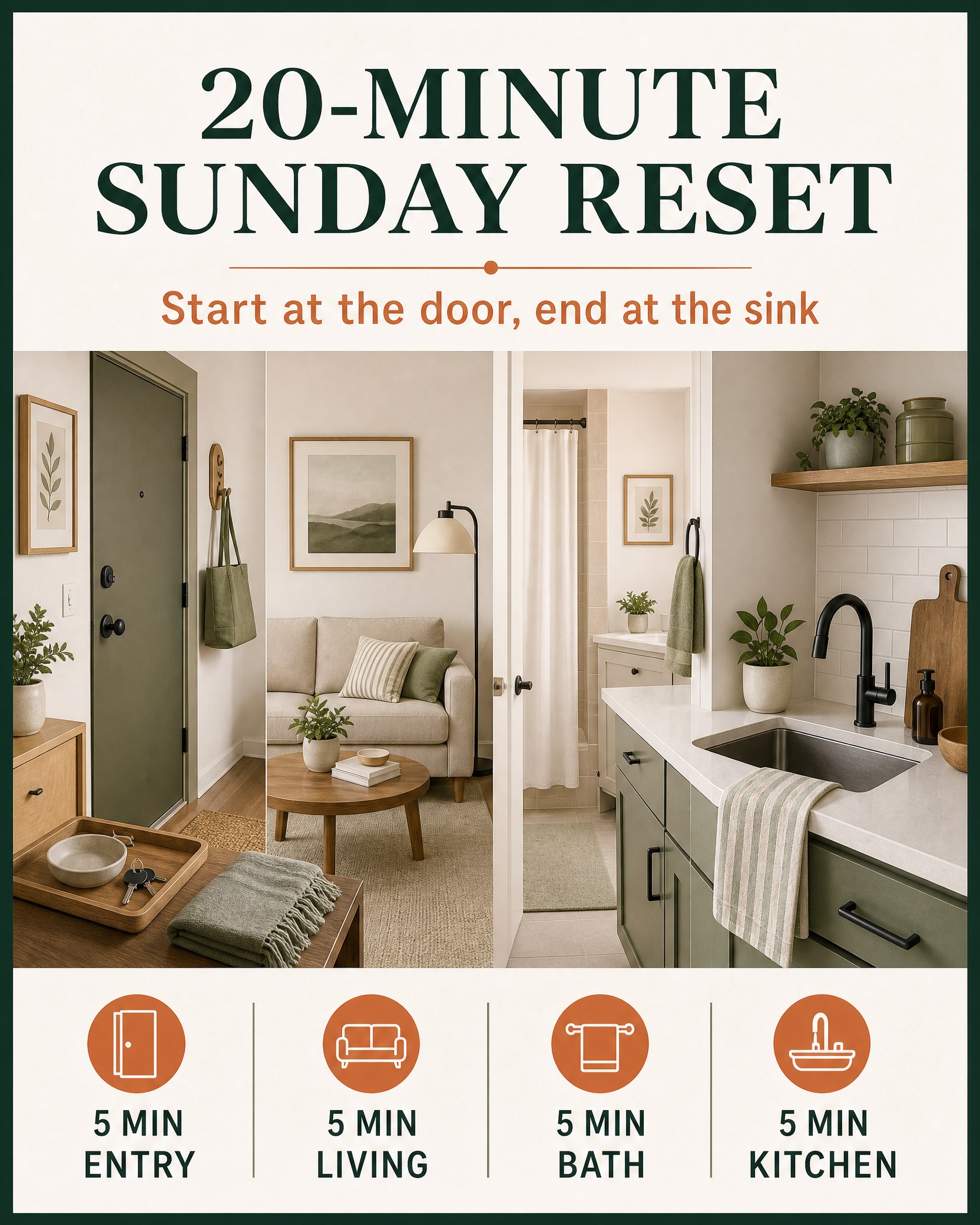
Living in a small home or renting often means your space reflects every day of the week. This short, focused routine gets you from threshold chaos to a calm, ready-for-Monday setup in 20 minutes—no heavy cleaning, just a purposeful reset.
The sequence goes from entrance to sink so you move through the apartment efficiently: drop and sort at the door, flatten living surfaces, freshen the bathroom, and finish in the kitchen with clean dishes and a prep area for the week. It’s repeatable, realistic, and built around what you can actually finish in 20 minutes.
Why a 20-minute Sunday reset works for a small home
Small homes fill up fast. Doing one deep cleaning session a week is often impossible, but 20 focused minutes reduces visual clutter and appliance friction for Monday. The goal isn’t perfection—it’s to remove obvious friction points (shoes in the entry, piles on the couch, a sink full of dishes) so you can start the week without small annoyances piling up.
Before you begin: set a timer and gather a small kit
Set a 20-minute timer on your phone or a kitchen timer. Gather a small kit you keep by the door or tucked under the sink: a microfiber cloth, multi-surface spray, a small trash bag, two baskets or tote bags for “keep” and “relocate,” and a dish towel. Keeping this kit compact avoids decision fatigue when Sunday arrives.
Entrance: 4 minutes — the drop-zone triage
Stand at the door with your two baskets. Do a rapid triage: one basket for things that belong immediately in another room (mail, dishes, laundry) and one for items you’ll actually keep near the entry (keys, mask, daily bag). Slide shoes into a quick, neat row or tuck them under a bench. If you have a coat hook or small console, give it a 30-second straightening.
Related guide: How to Create a Drop Zone in a Small Entryway
Living areas: 6 minutes — flatten, fold, and clear surfaces
Work quickly across high-impact zones: couch, coffee table, and dining surface. Flatten cushions, fold a throw, and stack stray papers into a slim, single pile to be dealt with later. Put items from your “relocate” basket where they belong. Don’t deep-clean upholstery or organize drawers—this is surface-level order to reduce visual clutter.
Small staging trick
Leave one visible flat surface mostly clear—one cleared surface makes the whole room feel tidier even if drawers and shelves are still full.
Bathroom: 3 minutes — refresh, not scrub
Clear countertops of empty bottles and toss trash. Wipe the sink and mirror quickly with the microfiber cloth. Replace used towels with a fresh one and empty the small trash if needed. Skip deep tile or grout work; aim for an impression of freshness rather than a full scrub.
Kitchen sink and Monday setup: 5 minutes — finish at the sink
The last stop is the kitchen sink—this is where the reset earns its name. Load the dishwasher or wash the few dishes that won’t fit. Wipe the counters, put away food containers, and clear a two-foot prep space so breakfast or a quick meal is easier Monday morning. If you have a meal plan or a packed lunch, place it where you’ll see it in the morning.
Related guide: The Weekend Apartment Reset: A Room-by-Room Plan for Less Clutter
Simple tools to keep handy
At-a-glance reference
| Item | Where to store | Use |
|---|---|---|
| Microfiber cloth | Under sink or entry kit | Quick surface wipe |
| Two small baskets | Entry or closet | Sort “keep” and “relocate” |
| Small trash bag | Back of a cupboard | Fast declutter and empty small bins |
| Timer | Phone or countertop | Keep the session honest |
Trade-offs and when to do more
This reset trades depth for consistency. You won’t deep-clean carpets, reorganize kitchen cabinets, or handle paper-heavy admin during this 20 minutes. Accepting those trade-offs means you gain a habit you’ll actually do each week. Schedule one longer session once a month or when something truly needs attention (deep kitchen clean, closet edit, or a laundry marathon).
How to customize for roommates or family
If you share the space, assign the first 20 minutes of Sunday or split tasks—one person does entry/living while the other handles bathroom/kitchen. Even a small home benefits from consistent roles: one quick pass is much more effective than none.
Clear next step
Pick a Sunday and commit: set a 20-minute timer, gather the kit, and start at the door. After one or two runs you’ll find the rhythm and decide which tosses or chores to schedule monthly. The clear next step is to do it—stop planning, set the timer, and move through the entrance-to-sink sequence once. Notice how much easier Monday morning feels.
FAQ
Can this routine replace a full weekend clean?
No. This routine is a maintenance reset for visual clutter and quick friction points. Plan separate deeper sessions for scrubbing, decluttering closets, or tackling papers.
What if 20 minutes isn’t enough?
If you consistently need more time, try two 10-minute passes or extend to 30 minutes once your habit is built. Keep the same sequence so the routine remains efficient.
How do I keep this from becoming a chore I avoid?
Keep the kit visible, celebrate small wins (a clear counter, an empty sink), and insist on the timer. Habit forms faster when the task is predictable and short—commit to four Sundays in a row and reassess.
Quick reminder: this is about reducing friction, not perfection. A small, consistent reset protects your time and your peace of mind.
Sources and fact-checking
This article provides practical editorial guidance. Safety, cleaning, disposal, rental, and product decisions can depend on the item, its instructions, and local requirements.
- U.S. Centers for Disease Control and Prevention — Cleaning and Disinfecting — For everyday home cleaning, use product-label directions; disinfecting may be appropriate when illness circumstances call for it.
Fact-checked against the linked official resources on August 27, 2026.