
Portable Washing Machine for Apartment: Check Hookups
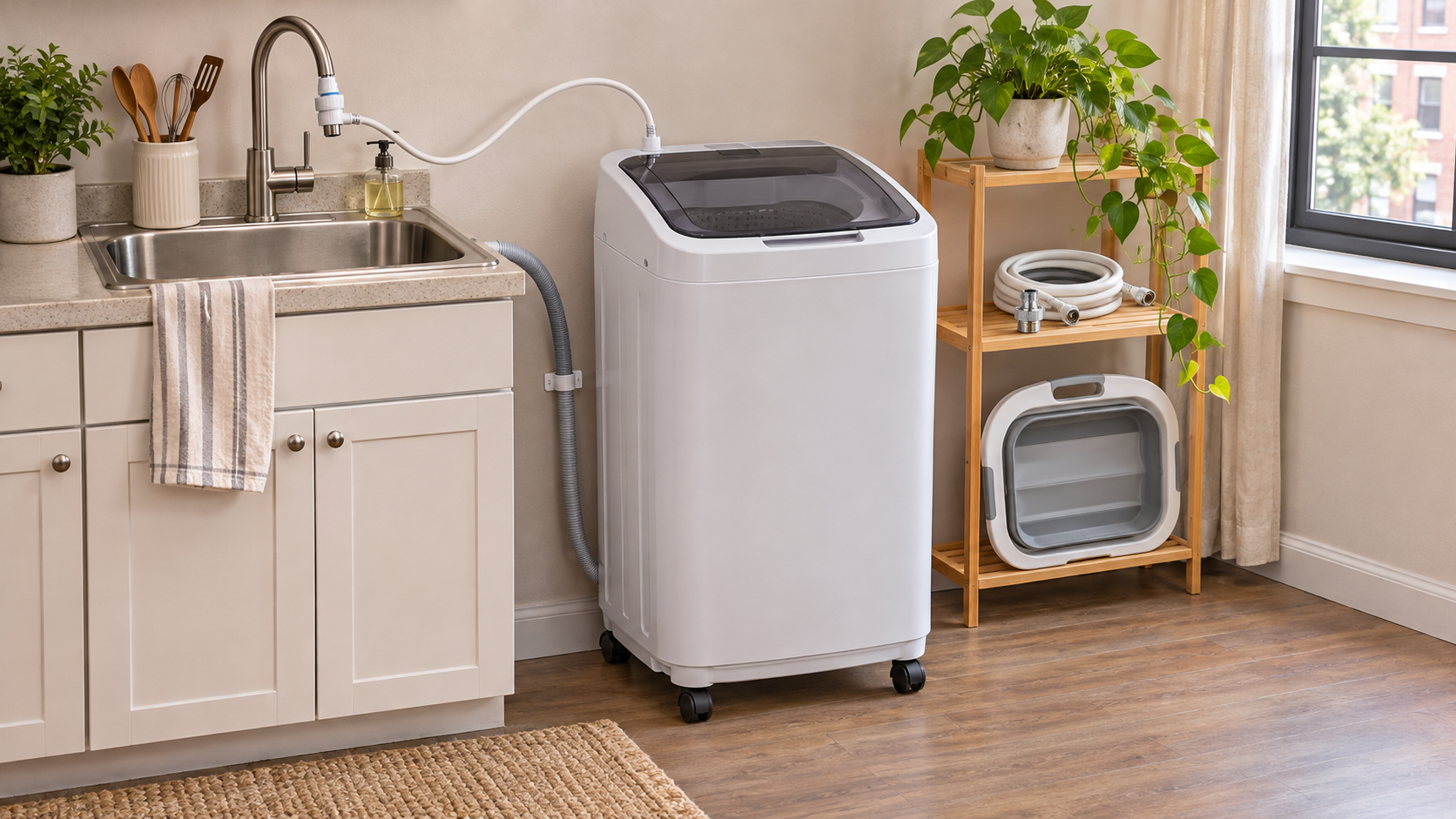
A portable washing machine for apartment living is useful only when the faucet, drain, outlet, floor, and storage route all fit the exact model. Measure those five things before comparing cycle counts or claimed load capacity. If one connection is wrong, a compact washer can become an expensive object you cannot safely use.
This guide is for renters and small-home residents who are comparing portable top-load washers, twin-tub machines, and other roll-away options. It does not assume that every lease permits one. Building rules, insurance requirements, plumbing conditions, and manufacturer instructions vary, so get written approval when your lease or management policy is unclear.
Portable washing machine for apartment: the five-part fit test
Start at the apartment, not at the product page. A listing can describe a washer as “portable” even when the machine is too wide for the route to the sink, incompatible with the faucet, difficult to drain, or too heavy to move after each load.
- Faucet: Identify the faucet type and whether its aerator can be removed without damage. Photograph the threads after removal and compare them with the adapter instructions for the exact washer.
- Drain: Confirm where the hose must sit, how high it may rise, and how it is secured. A hose that jumps out of a shallow sink can release a full wash load of water onto the floor.
- Outlet: Find a grounded wall outlet within reach of the original cord. Do not plan around an extension cord or power strip.
- Floor: Choose a hard, level surface that can stay dry and allows the washer to remain stable during spin.
- Route: Measure doors, turns, counter overhangs, and the parking space with hoses and handles included.
Write the limits down before shopping. “Fits under the counter” is not enough if the lid cannot open, the faucet hose bends sharply, or the unit blocks the only useful kitchen walkway.
Compare the three common portable washer formats
| Format | Best fit | Main tradeoff | Verify before buying |
|---|---|---|---|
| Compact automatic top-loader | Regular small loads near a compatible sink | Larger footprint and more water-connection parts | Faucet adapter, inlet pressure, drain height, lid clearance, loaded movement |
| Twin-tub washer and spinner | Users willing to transfer clothes manually | More hands-on filling, draining, and balancing | Fill method, gravity-drain position, spin capacity, splash control |
| Very small countertop or bucket-style unit | A few lightweight items | Limited capacity and inconsistent product quality | Actual wash volume, electrical listing, drain method, return policy |
Do not treat a small washer as a smaller version of a full-size machine. A twin-tub may require you to move wet clothing into a separate spinner. A compact automatic unit may need a threaded sink connection and a specific drain-hose position. A tiny unit marketed for socks or delicates may not replace weekly laundry at all.
Measure the whole route, not just the parking spot
Record the product’s full width, depth, and height, then add the parts that retailers often photograph separately: handles, wheels, hose connections, cord exit, lid swing, and quick-connect adapter. Measure the narrowest doorway and the sharpest turn between storage and the operating location.
A washer that rolls easily when empty may be awkward when water remains in a hose or tub. Plan to disconnect, drain, wipe, and store it according to the manual before moving it. Never pull the machine by its cord or hoses.
If laundry supplies already crowd the same area, use the existing small-space laundry organization plan to reserve one parking footprint for the washer and one dry zone for detergent. The machine should not become a shelf that must be cleared before every load.
Check the faucet before trusting “quick connect”
Portable washer adapters commonly depend on removable aerator threads, but faucets vary. Pull-down spray heads, sensor faucets, square outlets, recessed aerators, damaged threads, and specialty finishes can make a quick connector impractical or risky. Do not force an adapter that does not turn smoothly by hand.
Use the model’s manual to identify the supplied connector and any permitted adapter. Compare the thread type, available clearance around the faucet, and hose bend radius. If the connector would press against a backsplash or prevent normal sink use, choose another operating location or another washer.
Before the first wash, connect the empty machine, turn on the water slowly, and inspect the faucet, adapter, inlet hose, and washer connection. Stop if you see seepage, swelling, a loose coupling, or a hose that twists as pressure rises. Keep the sink drain open and remove dishes, food, and cleaning products from the splash area.
Plan drainage as carefully as water supply
Drainage is not simply “put the hose in the sink.” The manufacturer may specify a minimum or maximum hose height, a required hook or guide, and a limit on hose length. Some machines pump water upward; others depend more heavily on gravity. Follow the exact manual rather than copying another model’s setup.
Secure the hose using only the approved method so water flow cannot push it out. Check that the sink or tub drains faster than the washer discharges. A slow household drain, clogged strainer, or shallow basin can overflow even when the washer works normally.
Stay nearby for the first complete cycle. Watch filling, agitation, draining, and high-speed spin. If the hose moves, the sink backs up, or the washer walks across the floor, stop and correct the setup before running another load.
Use a wall outlet, not a convenient workaround
The U.S. Fire Administration says washers and dryers should be plugged directly into a wall outlet and that major appliances should not use extension cords. That rule matters in a small apartment because the nearest sink is not always near an appropriate outlet.
Confirm that the original cord reaches without tension and that the plug fits fully. Do not run the cord under a rug, through a doorway, or across a wet traffic path. If the outlet is loose, damaged, ungrounded, or repeatedly trips a breaker, stop and contact the landlord or a qualified electrician rather than changing the plug or using an adapter.
Keep the plug and outlet dry while connecting and disconnecting water hoses. The appliance manual is the final source for voltage, circuit, grounding, and placement requirements.
Match capacity to real loads, not optimistic photos
Portable washer listings may describe capacity in cubic feet, pounds, or a vague number of garments. Those figures are not interchangeable. Build a sample load from the items you actually wash: shirts, underwear, towels, sheets, or work clothes. Heavy wet towels and bulky bedding can exceed practical capacity quickly.
Compare drum capacity and the manufacturer’s load guidance, but also consider what will happen after washing. If you air-dry, the high-spin option and the amount of residual moisture may matter more than an extra cycle. If you still need a laundromat for bedding, decide whether the portable unit saves enough routine trips to justify its storage footprint.
ENERGY STAR advises buyers to compare size, typical load volume, and the yellow EnergyGuide label. Many very small portable models are below the capacity range eligible for ENERGY STAR clothes-washer certification, so the absence of the label should not be interpreted as proof of safety or efficiency. Compare the exact model’s EnergyGuide information when provided, water use, cycle design, and operating instructions.
Run a renter-safe first-load test
- Get any required written approval and review rules about portable appliances, water connections, and storage.
- Check the exact model and serial information in the CPSC recall database, especially when buying used or open-box.
- Read the complete installation and operating manual before attaching an adapter.
- Set the washer on the planned hard, level surface with the required clearances.
- Inspect the power cord, plug, inlet hose, drain hose, washers, and connector.
- Test water connections with the machine empty and the faucet opened slowly.
- Run the smallest permitted load while staying in the room for every stage.
- Afterward, shut off water if directed, disconnect as instructed, drain hoses fully, and wipe the surrounding floor.
A first-load test is also a noise and vibration test. If the spin cycle is disruptive, do not solve it with improvised foam, unstable platforms, or overloading. Recheck leveling, load balance, floor suitability, and the manufacturer’s troubleshooting steps.
Common buying mistakes
- Choosing by pound capacity without checking drum volume or the manual’s load examples.
- Assuming every kitchen faucet accepts the included adapter.
- Planning to solve a short power cord with an extension cord.
- Ignoring lid clearance under a counter or wall cabinet.
- Measuring the washer body but not the hoses, handles, wheels, and turning route.
- Using a slow or shallow sink without testing the drain rate.
- Buying a used unit without checking the model and serial number for recalls.
- Expecting a small washer to handle comforters, heavy blankets, or all household laundry.
If the portable washer passes the fit test, pair it with a realistic small-apartment laundry routine rather than storing several oversized loads. For building laundry days or items too bulky for the machine, keep the apartment-building laundry checklist available.
Frequently asked questions
Can I use a portable washing machine in any apartment?
No. The lease or building may restrict portable appliances, and the apartment still needs a compatible faucet, approved drain setup, suitable floor, correct outlet, and safe storage route. Confirm rules and the exact model instructions before buying.
Do all portable washers connect to a kitchen sink?
No. Connector designs and faucet compatibility differ. Pull-down sprayers, hidden aerators, unusual threads, and limited clearance can prevent a secure connection. Check the supplied adapter and manual against the actual faucet.
Can I use an extension cord with a portable washer?
No. The U.S. Fire Administration says major appliances, including washers, should plug directly into a wall outlet and should not use an extension cord. Follow the washer’s electrical instructions as well.
Should I buy the largest portable washer that fits?
Not automatically. A larger tub can mean a heavier, deeper machine with a longer turning radius and greater storage demands. Choose the smallest model that handles your normal loads while still fitting the faucet, drain, outlet, floor, and route.
Sources and fact-checking
This guide was reviewed on November 14, 2026. Model dimensions, connectors, electrical requirements, drain limits, load guidance, and maintenance steps must be checked in the current manual for the exact washer.
- ENERGY STAR — Clothes Washers: buying guidance on washer size, EnergyGuide comparison, capacity, water and energy efficiency, and maintenance.
- U.S. Fire Administration — Appliance and Electrical Fire Safety: direct-wall-outlet and extension-cord guidance for major appliances.
- U.S. Consumer Product Safety Commission — Recalls & Product Safety Warnings: model-specific recall checks before purchase or use.


댓글 0
첫 댓글을 남겨보세요.