
Vacuum Storage Bags: What to Compress and What to Avoid
Vacuum storage bags save volume only when the contents are clean, fully dry, and suitable for compression. They work best for bulky seasonal bedding and washable textiles that can tolerate being packed tightly. They are a poor default for damp items, fragile keepsakes, items with sharp hardware, or materials whose care instructions warn against compression.
The buying decision should start with the stored item and the final compressed bundle, not the number of bags in the package. A jumbo bag that becomes a heavy, slippery block may be harder to lift and shelve than two smaller bags.
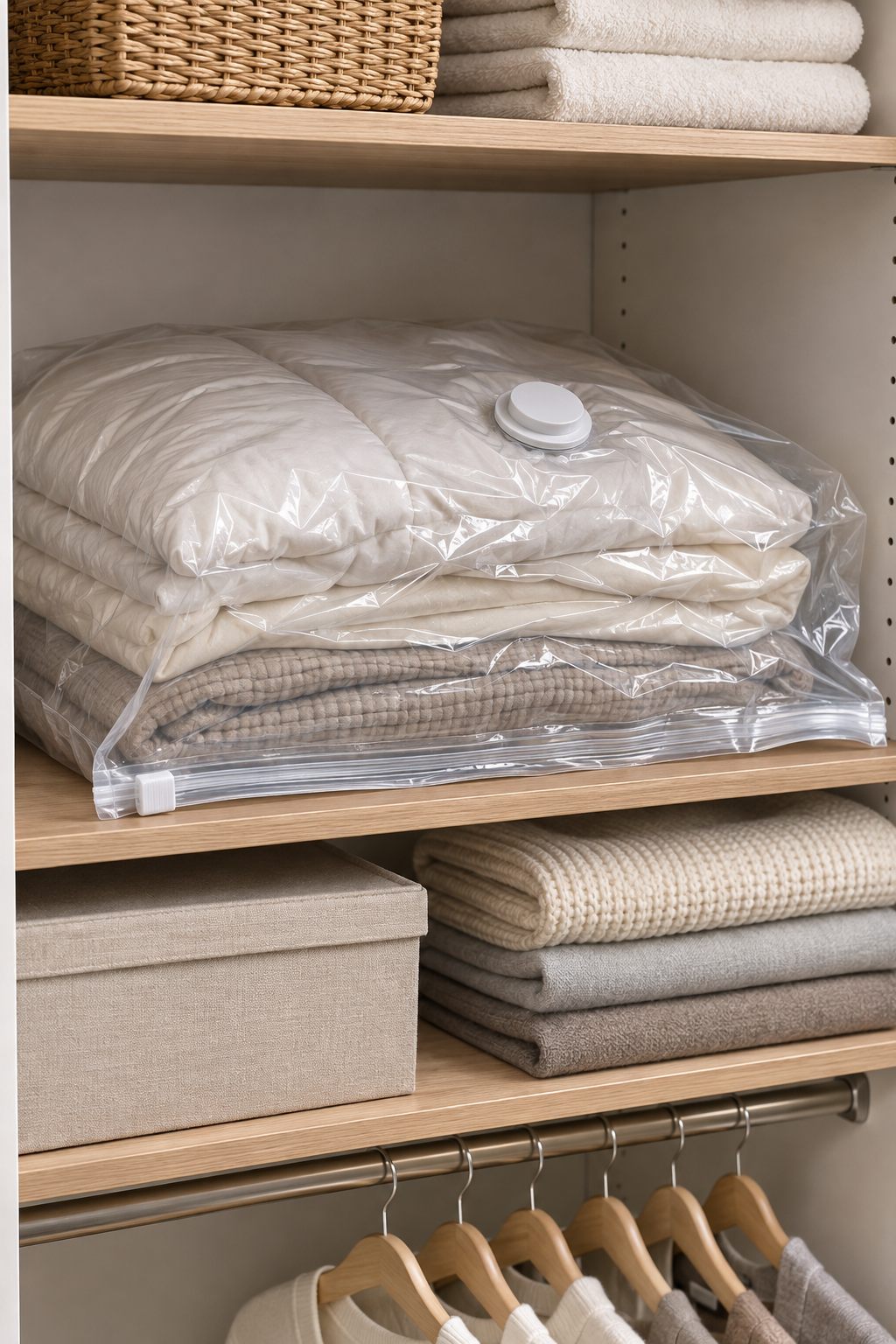
What vacuum storage bags actually change
The bag removes air around soft contents and reduces their occupied volume. It does not reduce weight, clean the item, repair moisture damage, or guarantee an indefinite seal. Valves, zippers, folds, and punctures can allow air back in over time.
Treat dust, moisture, odor, and pest claims carefully. A properly sealed bag creates a barrier, but packing a damp textile can trap the moisture inside. EPA guidance emphasizes moisture control and fully drying wet items to prevent mold growth.
- Flat vacuum bag: efficient for shelves and under-bed spaces when the final dimensions are planned.
- Cube-style bag: easier to stack but may compress less evenly.
- Hanging vacuum bag: preserves closet placement but adds load to the rod.
- Travel roll bag: removes air by rolling and suits smaller, frequently opened contents.
Match the bag to the contents
Use the care label and the item’s construction as the first filter.
| Contents | Usually suitable? | Main risk | Better practice |
|---|---|---|---|
| Washable blankets and synthetic bedding | Often | Moisture, excess bundle weight, slow seal loss | Wash, dry completely, use a manageable bag size |
| Seasonal clothing | Often | Wrinkles, hidden dampness, frequent reopening | Group by season and label the outside |
| Down, wool, structured garments | Check care guidance | Loss of loft, prolonged compression, material damage | Use breathable storage when the care instructions require it |
| Documents, leather, sharp hardware, electronics | Generally avoid | Puncture, abrasion, trapped moisture, unsuitable environment | Use purpose-specific protected storage |
If the item has an important care label or manufacturer storage instruction, that guidance controls. Do not rely on a bag seller’s broad list of compatible contents.
Measure the final bundle, not the empty bag
The empty dimensions describe the plastic sheet, not the compressed package. Fill a normal laundry bag or pillowcase with the intended contents, press it gently, and measure the likely shelf footprint. Leave space for the valve and a smooth zipper area.
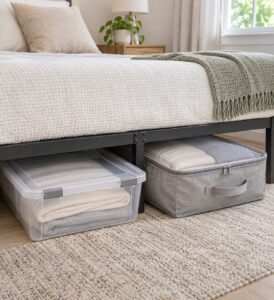
For under-bed storage, measure the lowest clearance across the entire route, including bed slats, center supports, rug edges, and the path used to slide the bundle in. The older under-bed storage guide helps decide whether the location is appropriate before you buy compression products.
Pack only clean and fully dry textiles
A bag does not make a damp item safe. After washing, allow thick seams, quilted layers, cuffs, and elastic areas to dry completely. If the storage area has condensation or a history of leaks, fix the moisture problem first.
EPA states that moisture control is the key to mold control and recommends drying wet or damp items promptly. That supports a simple rule: do not compress textiles that feel cool, smell musty, or came from a humid space without complete drying.
Protect the zipper, corners, and valve
Keep buttons, buckles, zippers, and stiff corners away from the plastic wall. Fold hardware inward or use a smooth fabric layer around it. Do not overfill the zipper track; a flat clean sealing area is more important than squeezing in one more sweater.
Match the valve to your vacuum hose or choose a set with a pump you can actually use. Hold the valve steady rather than pressing the hose against the bag with your full weight. Replace the cap exactly as directed.
Choose access frequency before size
A bag opened every week is not seasonal storage. Put frequently used towels, guest bedding, or children’s sizes in smaller labeled groups. Keep true off-season items together so one opening does not release every bag.
The seasonal clothes storage system can help define the rotation. For bulky bedding, use the small-home bedding storage guide to decide what should remain accessible and what can move to deep storage.
Plan shelf and closet loads
Compression reduces volume but keeps the full weight. Do not stack heavy slippery bags above shoulder height or load a closet rod with multiple hanging bags without checking its condition and capacity. Keep the heaviest bundles low and supported.
If the closet itself needs a reset, complete the small closet organization plan before purchasing bags. Compression creates space, but it should not replace editing items you no longer use.
Inspect and reseal on a schedule
Check bags after a day, a week, and then seasonally. A slowly expanding bag may have debris in the zipper, a loose cap, a fold near the seal, or a puncture. Do not stack more weight on a leaking bag to keep it compressed.
Label the contents and packing date on a removable tag outside the plastic. Avoid writing directly over a fold or sealing area. If an item smells damp when opened, move it to a dry ventilated area and investigate the storage conditions.
Run a one-bag pilot test
Test one realistic load before committing the full closet.
- Choose ordinary washable items approved for compressed storage.
- Wash and dry them completely, including thick seams.
- Fill only to the product’s line and keep the seal area flat.
- Remove air, cap the valve, and record the final dimensions and weight.
- Inspect after 24 hours and one week before packing the rest.
A successful pilot should remain sealed, fit the planned location, and be easy for the intended person to lift and retrieve.
Common buying mistakes
- Packing damp, dirty, musty, or warm textiles.
- Using jumbo bags that become too heavy to move safely.
- Compressing items whose care instructions require breathable storage.
- Letting hardware or sharp corners press against the plastic.
- Assuming the seal will remain perfect without periodic checks.
Frequently asked questions
Can vacuum storage bags cause mold?
The bag does not create mold by itself, but it can trap moisture with the contents. Pack only clean, fully dry items and avoid damp storage locations.
Are vacuum bags good for down comforters?
Check the comforter manufacturer’s care and storage instructions. Prolonged compression can be inappropriate for materials that depend on loft.
Why does the bag fill with air again?
Common causes include debris in the zipper, an incompletely closed track, a loose valve cap, a folded seal, or a small puncture.
Should I buy jumbo or mixed-size bags?
Mixed sizes are often easier for a small home because they keep bundles lighter and let you open only the category you need. Measure the storage location first.
Sources and fact-checking
This guide was checked against the following current sources. Product dimensions, load limits, materials, mounting instructions, warranties, and return terms still need to be verified on the exact listing before purchase.
- U.S. Environmental Protection Agency — A Brief Guide to Mold, Moisture and Your Home — supports moisture control and fully drying wet or damp items
- U.S. National Archives — Storing Family Papers and Photographs — helps distinguish ordinary textile compression from the appropriate storage of paper and photograph collections



댓글 0
첫 댓글을 남겨보세요.