The Small Bedroom Reset Routine That Makes Mornings Easier
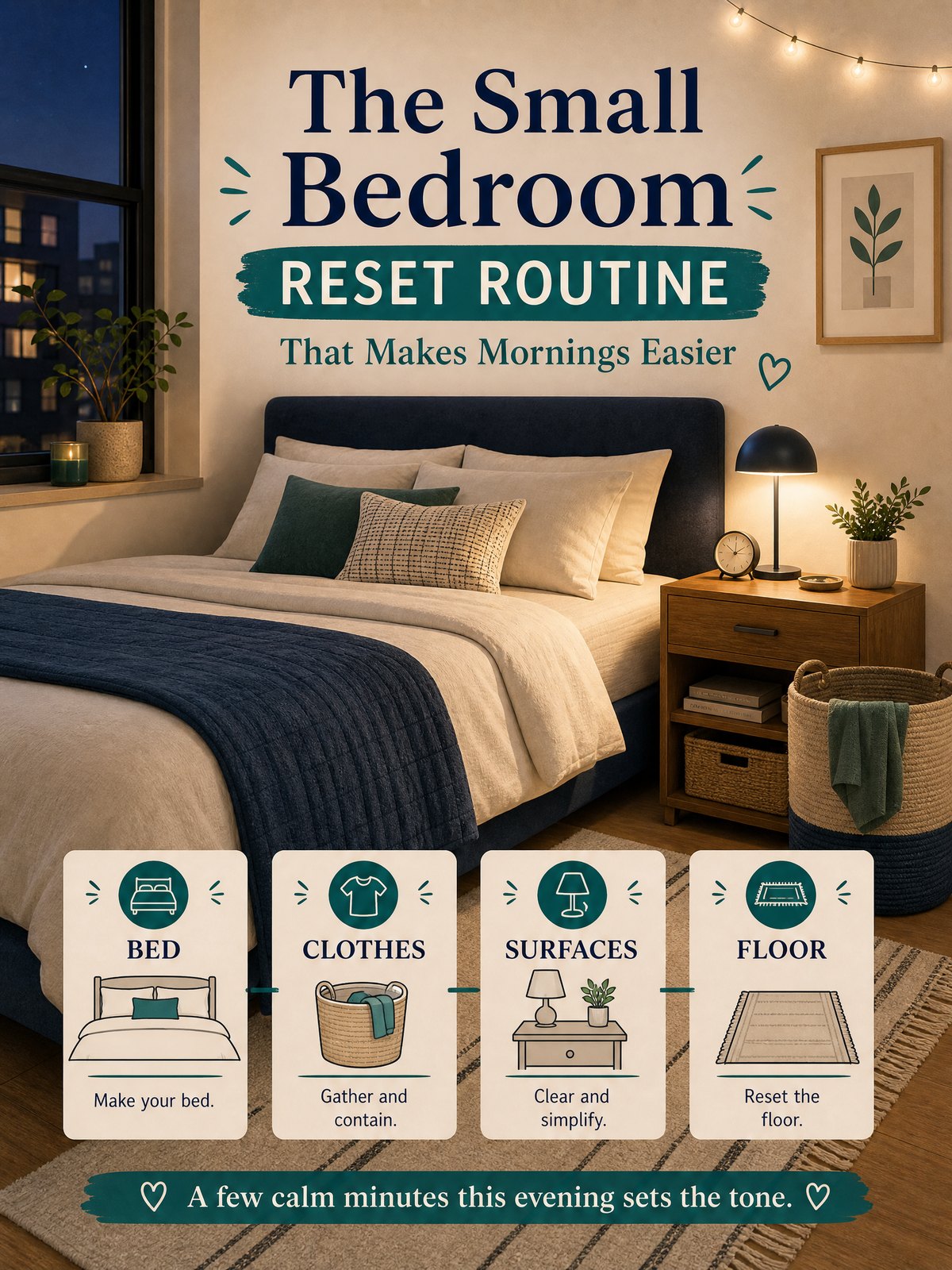
Most mornings feel harder than they need to because your bedroom creates tiny decision points: what to do with the unmade bed, where the clothes pile goes, whether that surface is keeping a mess, and what to do with laundry. Those four areas add friction that makes leaving on time more difficult.
This reset routine uses a fixed sequence—bed, clothes, surface, laundry—that you can run in a few minutes before you walk out or when you first get up. The goal is not perfection but a predictable small set of actions that reduces morning decisions and clears a path out of the room.
Start with the real constraint
The true limiting factor in a small-bedroom routine is attention and time, not storage or money. When you have one to five minutes, your system must eliminate choice fatigue so the default action is obvious. That means reducing tasks to visible, repeatable moves rather than long organizing projects.
Another real constraint is how often you can realistically do a reset. If you commit to a routine you can do daily, it beats a perfect procedure you never follow. Treat the routine as a short daily investment: a few deliberate moves now that save five to fifteen minutes and mental clutter later.
When you touch cleaning products or laundry supplies, follow the product label and manufacturer instructions. If your rental agreement includes rules about appliance use, heat, or storage, follow your lease and any local rules. For surface cleaning, note that the U.S. Centers for Disease Control and Prevention distinguishes cleaning with soap and water from disinfecting, and says cleaning alone is sufficient in most situations unless illness-related circumstances make disinfection appropriate.
At-a-glance plan
| Task | Time | Decision signal | Quick action |
|---|---|---|---|
| Make the bed | 30–60 seconds | Sheets are loose or pillows askew | Straighten sheet, tuck corners, fluff pillows |
| Sort clothes | 30–90 seconds | Items on chair or floor | Place worn-but-clean in hanger/bin; dirty to hamper |
| Clear one surface | 45–90 seconds | Surface has more than three items | Put items in designated spots: baseline, bag, or donate box |
| Deal with laundry | 30–60 seconds | More than one load’s worth around the room | Start a load, consolidate into basket, or set a reminder |
Build the system step by step
- Decide your zones: pick a single place for worn-but-clean clothes, one hamper spot for dirty laundry, and one small landing for keys/phone. Keep these within reach to reduce wandering decisions.
- Create a 90-second bed routine: smooth the top sheet and comforter, straighten pillows, and pull a throw over the foot of the bed if you use one. The visible neatening lowers stress even if the bed isn’t perfectly made.
- Adopt a two-bin clothes habit as a practical option: one visual spot for “wear again” and one hamper for washing. Make the “wear again” bin or hanger easy to reach so putting clothes there is faster than leaving them on a chair.
- Choose one surface to protect: nightstand, dresser, or a small shelf. Keep a single small container on it for loose items (wallet, glasses, watch). Clear everything else into an inbox or return pile in under two minutes.
- Set a simple laundry trigger: when the hamper reaches a visible line or you have a basket that fills, start washing; otherwise put laundry basket near door as a reminder. Use a phone reminder if you need it as a personal planning approach.
Those five steps create a small, repeatable flow: zone decisions make sorting fast; the bed routine gives an immediate visual payoff; the two-bin clothes habit prevents piles; the protected surface reduces clutter; and the laundry trigger keeps dirty clothes from creeping back in. Practically, you can do the whole sequence while you wait for your coffee or as the last thing before you leave.
Trade-offs to consider
No single approach fits every small bedroom. Choose the trade-offs that match your priorities: speed, tidiness level, or minimal rules.
- Speed vs. perfection: Faster routines save time but accept a lived-in look; more thorough tidying takes longer and may not be repeatable daily.
- Visible systems vs. hidden storage: Keeping a “wear again” hanger visible speeds decisions but can look less neat than hiding everything in storage.
- Rigidity vs. flexibility: Strict rules (e.g., “everything has a home”) reduce decision load but can feel restrictive; looser habits are easier to maintain but may allow clutter to drift back.
Keep it workable
Maintenance is the only thing that makes a short routine stick. Spend two minutes each evening or morning on the reset and use weekly micro-sessions—ten minutes on the weekend—to handle overflow: folded linens, small donations, and reorganizing the landing spot. If something in the routine feels consistently ignored, change that single step rather than abandoning the whole process.
FAQ
How long will this actually take each day?
Expect to spend three to six minutes total the first few times as you build the habit; over a week it typically falls into the two- to four-minute range for most people if you limit actions to the four key areas.
What about cleaning surfaces for hygiene?
For routine upkeep, wiping with soap and water or a general-purpose cleaner is usually sufficient; the U.S. Centers for Disease Control and Prevention distinguishes cleaning with soap and water from disinfecting, and says cleaning alone is sufficient in most situations unless illness-related circumstances make disinfection appropriate. Always follow product labels and manufacturer instructions when using cleaners.
My roommate or landlord has different habits—how do I keep this working?
Focus on the area you control and make the system as low-friction as possible; for shared spaces, discuss simple shared rules and always follow lease provisions and local rules about appliance and space use.
Try the routine for a week and notice which step causes the most friction; adjust that step into a simpler option. After that week, keep the four-point flow as your baseline.
Sources and fact-checking
This guide provides practical editorial guidance. Requirements and safe choices can depend on the product, lease, local rules, and individual situation.
- U.S. Centers for Disease Control and Prevention — Cleaning and Disinfecting — CDC distinguishes cleaning with soap and water from disinfecting, and says cleaning alone is sufficient in most situations unless illness-related circumstances make disinfection appropriate.
Fact-checked against the linked official resources on August 27, 2026.