Declutter Bathroom Before Moving: Keep, Pack, or Dispose
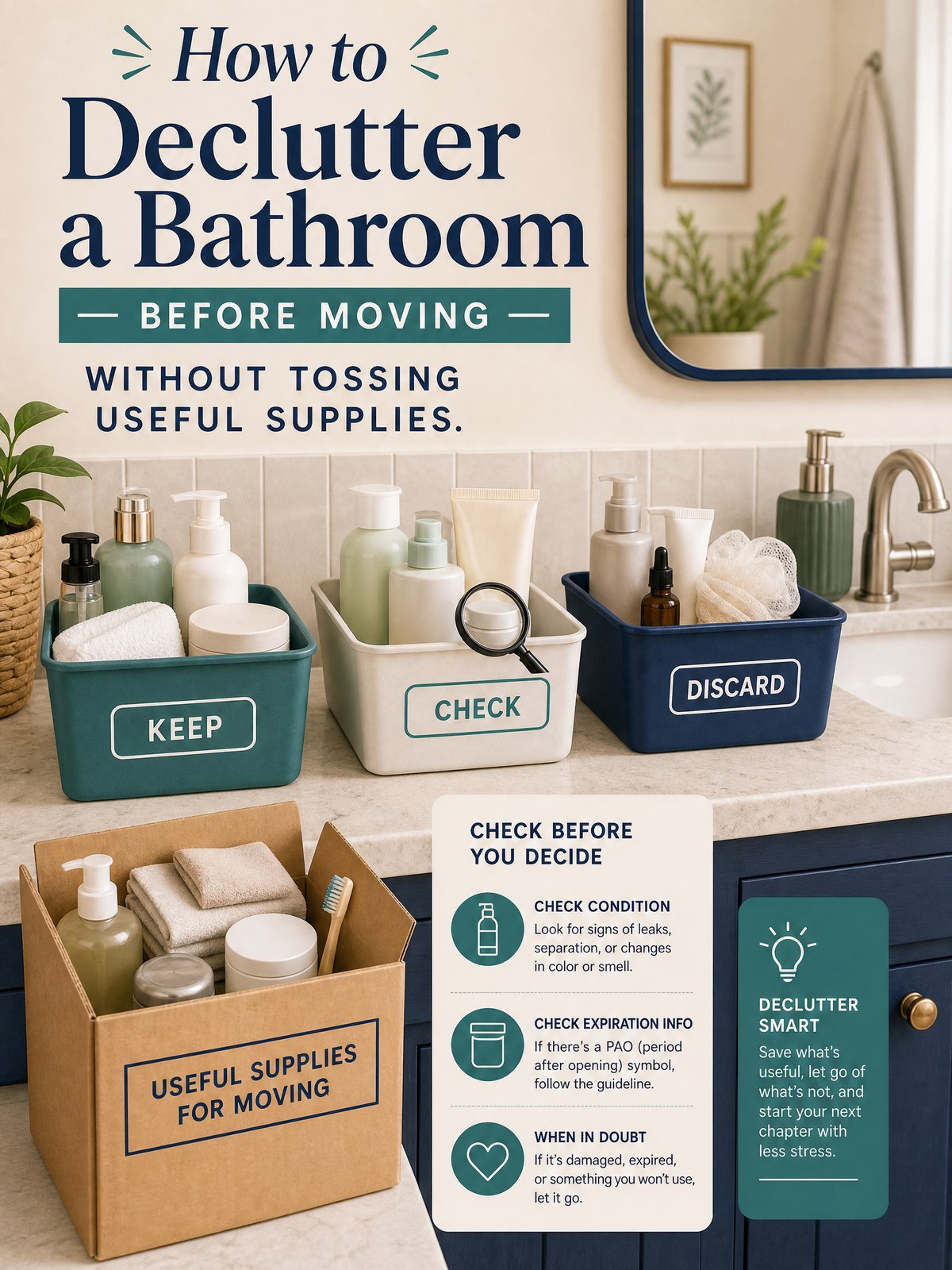
This guide focuses on declutter bathroom for U.S. renters and small-home movers, with a practical system for choosing what to buy, what to prepare, and what to verify before moving day.
Moving forces decisions about what to take, what to gift, and what to dispose of. In a small bathroom, supplies accumulate quickly: mismatched containers, half-used cleaners, expired prescriptions you don’t want to carry, and single-use items you might want to keep.
This guide gives a stepwise way to sort toiletries, medications, cleaners, and empty containers so you leave with useful items and discard or hand off what you must. It highlights labeling, simple decision signals, and when to check product labels or local rules.
Start with the real constraint
Space and weight govern moving decisions more than sentiment. If you will pay by volume or move yourself, every bottle and jar adds bulk; if you use a compact shipment or carry-on, liquids and aerosols may be limited. Treat those limits as the primary constraint for what you pack versus what you rehome or dispose of as a practical option.
Also accept that some items require special handling. The U.S. Environmental Protection Agency notes that products such as paints, cleaners, oils, batteries, and pesticides can need special disposal care, and advises following labels and local collection guidance. When in doubt, plan a short verification step with your local waste or recycling authority.
At-a-glance plan
| Task | When to do it | Decision signal | Next action |
|---|---|---|---|
| Empty the cabinets and sort items by type | 2–3 hours the week before moving | Group sizes show duplicates and near-empty products | Set aside: keep, donate/gift, special disposal, or recycle |
| Check labels and consolidate containers | Same day as sorting | Readability, product name, and hazard icons | Combine like products only as a practical option and relabel |
| Handle medications separately | Immediately after sorting | Prescription bottles, expired dates, or no instructions | Verify disposal options with pharmacy or local authority |
| Pack and label the boxes | At packing time | Fragile liquids, aerosols, and cleaning chemicals present | Use leakproof wrapping, label contents and destination room |
Build the system step by step
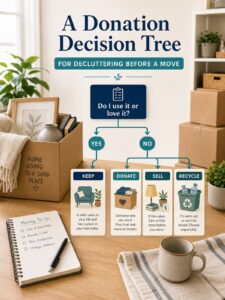
- Clear a staging area. Spread a towel or sheet on the floor and set up four bins or boxes labeled: Keep, Donate/Gift, Special Dispose, Recycle/Empty.
- Empty every cabinet, drawer, and shower caddy into the staging area. Group like with like — skin care, hair products, dental, first aid, cleaning agents, and single-use disposables.
- Read labels. For bottles with hazard information or unclear disposal instructions, place them in Special Dispose and plan to check local collection rules; this follows the EPA prompt to follow labels and local collection guidance.
- Treat medications separately. Do not mix pills with other waste. Ask a pharmacy or local authority about accepted return programs or take-back events as a question to verify locally.
- Pack thoughtfully. Transfer only stable, clearly labeled products into moving containers. Wrap liquids, mark boxes “Liquids—Bathroom,” and keep a small toiletries kit for immediate use after arrival.
After the five steps, you should have a pared-down collection to bring, a donation pile of unopened or gently used items, and a clearly separated set of products that need special disposal. Where you see unclear or worn labels, treat the item as a special-disposal candidate or verify locally before moving it.
Trade-offs to consider
Deciding whether to keep, donate, or dispose of each item involves balancing convenience, cost of transport, and safety. Below are three common trade-offs to weigh.
- Keep bulky but expensive items (e.g., a high-end shampoo) as a practical option versus buying replacements to reduce move weight.
- Donate usable toiletries to reduce waste and help others, recognizing some shelters accept only unopened items; check with the organization as a question to verify locally.
- Move small bottles instead of consolidating at the last minute to avoid cross-contamination, which is a personal planning approach if you value product integrity.
Keep it workable
After the move, set a 15- or 30-minute routine to re-evaluate bathroom supplies monthly for the first three months. Label opened items with a date as a personal planning approach to track how long an item has been in use. Keep cleaning and hazardous products on a high shelf or in a locked cabinet if safety is a concern, and follow any lease rules about storage of chemicals or hazardous materials.
Declutter Bathroom Categories in the Right Order
To declutter bathroom supplies efficiently, start with the items that create the greatest safety risk: medicines, cleaners, aerosols, and leaking containers. Then sort daily toiletries, backups, linens, tools, and decorative items. This order prevents a nearly empty bottle of shampoo from receiving more attention than an unlabeled chemical or unused prescription.
Create four destinations: use before moving, pack, local disposal, and trash or recycling where accepted. Do not combine similar cleaners or toiletries into one container. Keep the original label attached, especially when the product has hazard warnings or disposal directions. For unused medicine, use a drug take-back option when available and follow current FDA disposal guidance rather than improvising.
Pack liquids as a controlled category
Tighten caps, place each bottle in a sealable bag, and keep the bags upright in a rigid bin. Separate cleaners from personal-care products. A simple count of backups can also prevent buying duplicates for the new home. If you are reducing more than one room, the donation pickup guide explains how to prepare usable household goods, while the electronics recycling guide covers devices that do not belong in a bathroom donation box.
Finish by leaving a small final-use pouch outside the packed bin. That keeps moving-morning items available without reopening several boxes. Record anything the landlord must repair, such as a leak or damaged ventilation, before cleaning changes its appearance.
FAQ
Can I combine similar cleaners into one bottle to save space?
Combining like cleaners can reduce volume but should be done only as a practical option: ensure the formulas are compatible, relabel the container with contents and date, and keep the original labels or photos of them until you are certain mixing caused no issues. For any product with hazard symbols, follow the label and consider placing it in Special Dispose instead.
What should I do with expired medications I find while packing?
Do not flush or toss medications in household trash without checking local guidance; ask a pharmacy or municipal authority about approved take-back programs or disposal instructions as a question to verify locally, and follow any instructions they provide.
Do I need to disinfect my toiletries before packing?
The U.S. Centers for Disease Control and Prevention distinguishes cleaning with soap and water from disinfecting, and says cleaning alone is sufficient in most situations unless illness-related circumstances make disinfection appropriate; decide based on whether someone in the household is ill and follow CDC guidance if disinfection is needed.
When you finish sorting, label boxes clearly and set aside the Special Dispose items for one last check with local rules. If possible, schedule a donation drop-off or pharmacy visit before moving day to avoid last-minute disposal decisions.
What bathroom items should stay out until moving morning?
Keep one towel, basic toiletries, toilet paper, hand soap, any daily medication, and a small cleaning cloth accessible. Pack the rest by category and place liquids upright in a sealed bin.
Sources and fact-checking
This guide provides practical editorial guidance. Requirements and safe choices can depend on the product, lease, local rules, and individual situation.
- U.S. Environmental Protection Agency — Household Hazardous Waste — EPA notes that products such as paints, cleaners, oils, batteries, and pesticides can need special disposal care, and advises following labels and local collection guidance.
- U.S. Centers for Disease Control and Prevention — Cleaning and Disinfecting — CDC distinguishes cleaning with soap and water from disinfecting, and says cleaning alone is sufficient in most situations unless illness-related circumstances make disinfection appropriate.
- FDA — Disposal of Unused Medicines — FDA provides current options for take-back and, when appropriate, household disposal of unused medicines.
Fact-checked against the linked official resources on November 1, 2026.