Under Sink Storage Ideas for Cleaning Supplies in Small Homes
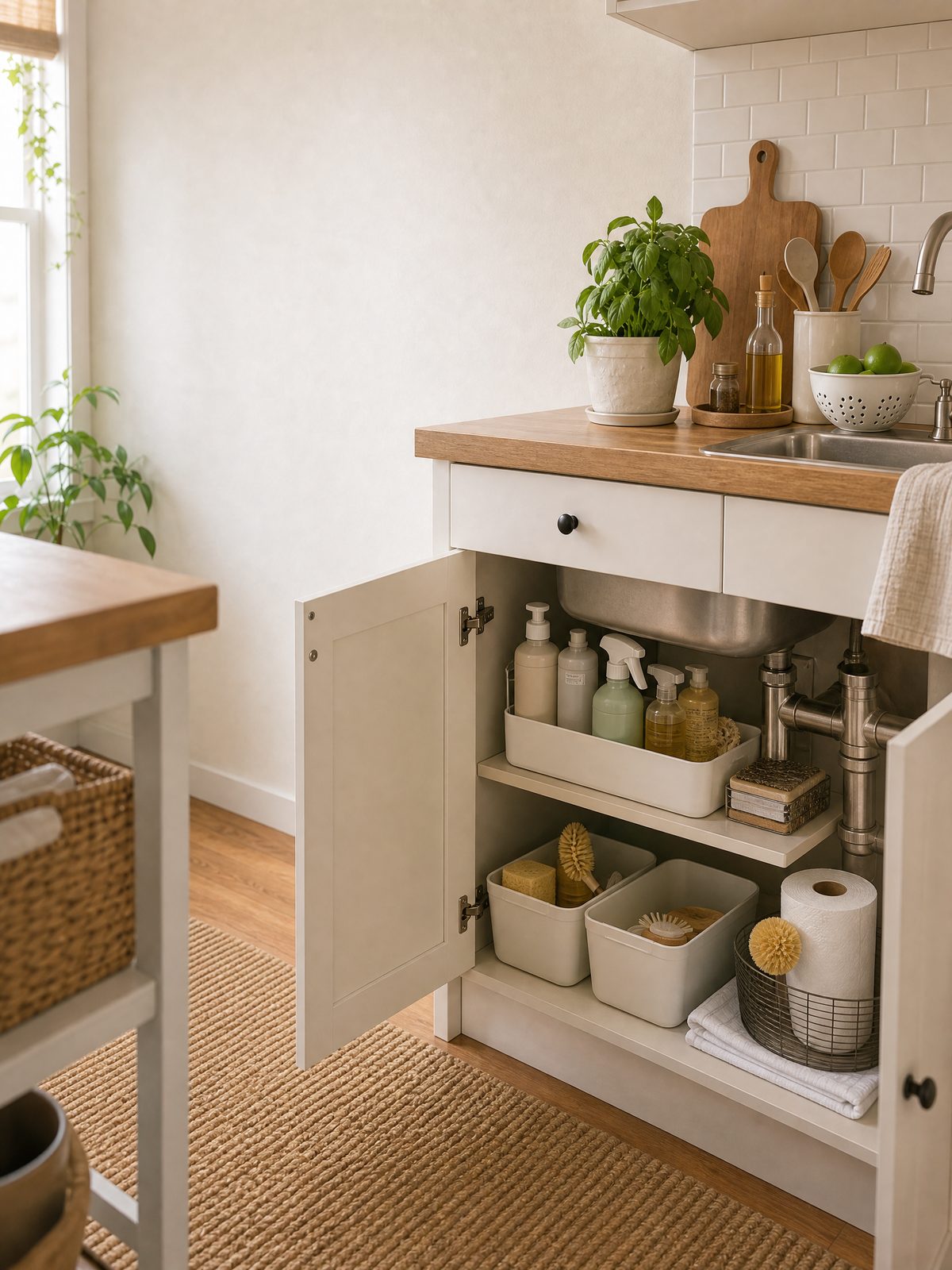
Good under sink storage ideas start with the pipes, not the products. Measure the usable space around the drain and shutoff valves, keep leak-prone bottles in removable trays, and choose organizers you can lift out quickly when plumbing needs attention. In a small home, the goal is not to fill every inch. It is to make everyday cleaning supplies visible while keeping labels readable, incompatible products separate, and anything unsafe for children or pets in a more secure location.
This guide shows how to turn an awkward kitchen or bathroom cabinet into a practical cleaning zone without drilling into a rental cabinet. You will also learn when a caddy, bin, drawer, or shelf is worth buying and when the safest choice is to store a product somewhere else.
Measure the cabinet before buying an organizer
Open the cabinet fully and remove everything. Measure the interior width, depth, and height, but do not stop there. Record the position of the P-trap, disposal, supply lines, shutoff valves, and any filter or dishwasher hose. An organizer that fits the cabinet dimensions can still block a valve or collide with a pipe.
- Mark the no-storage zone: Leave clear access to shutoff valves, slip nuts, and the base of the drain.
- Measure the door opening: A wide bin may fit inside but fail to pass the hinges.
- Check vertical clearance: Spray triggers and tall bottles often need more height than the front edge suggests.
- Look for moisture evidence: Staining, softened shelf material, corrosion, or a persistent odor deserves attention before organizers go back in.
If you find active dripping or a wet cabinet base, remove the stored products and address the leak first. A tray can contain a small product spill, but it is not a plumbing repair.
Compare four under-sink organizer types
| Organizer | Best for | Main trade-off | What to measure |
|---|---|---|---|
| Handled caddy | A small set of products used throughout the home | Tall bottles can tip if the base is narrow | Tallest bottle and door opening |
| Shallow leak tray | Bottles that may drip and items used weekly | Adds containment, not extra levels | Clear floor area around plumbing |
| Pull-out drawer | Deep cabinets where items disappear in back | Rails may reduce width and hit pipes | Pipe position, drawer travel, hinge clearance |
| Adjustable shelf | Short bottles, cloths, and refills in mixed heights | Can make valves harder to reach | Shelf legs, plumbing gaps, bottle height |
For many renters, the most flexible combination is a washable tray on the cabinet floor plus one removable caddy. It costs less than a fitted pull-out system, keeps the plumbing visible, and can move to the next home. A shelf or drawer makes sense only when its dimensions solve a specific access problem.
Build a visible cleaning zone step by step
1. Sort by use and risk, not by bottle color
Create a small everyday group, a less-used refill group, and a separate group for products that should not remain under the sink. The U.S. Environmental Protection Agency advises following product labels for storage and disposal and keeping potentially hazardous products in their original containers with labels intact. Do not pour a cleaner into a drink bottle or an unlabeled decorative container.
Households with children, pets, or a vulnerable adult may need a locked or otherwise inaccessible storage location rather than a low cabinet. Federal Poison Help guidance likewise says to keep cleaners in their original containers, follow label directions, and keep poisonous chemicals out of children’s reach.
2. Remove duplicates and products that do not belong
Keep only the products you actually use in this cabinet. Move seasonal or specialized items to a separate, suitable location so they do not hide leaks or crowd out daily supplies. If you have older products you no longer want, read the label and check your local solid-waste or household hazardous-waste program. Disposal options vary by product and community.
For a broader small-home system, see our renter-friendly cleaning-supply organization guide. If you are rotating products by season, use the safety checks in our seasonal cleaning-supply storage plan.
3. Give every bottle a readable front
Store bottles upright with the label facing forward. Avoid stacking products behind one another unless the back row is elevated and still visible. A simple rule works well: if you cannot identify and remove an item without moving three others, the zone is too dense.
Labels should describe the zone, not replace the manufacturer’s product label. “Daily surface care” or “Dish area” is useful on a bin; relabeling an original chemical container is not. Shared households can adapt the room-based system in our guide to home organization labels for shared spaces.
4. Use secondary containment without creating a hidden mess
A shallow, washable tray makes small drips easier to notice and keeps bottles from sitting directly on the cabinet floor. Choose a tray you can remove without tilting it around the drain pipe. Transparent or open-top bins make inventory easier than opaque lidded boxes, especially in a dark cabinet.
Do not use a tray as permission to crowd incompatible products together. Follow each product label, keep lids closed, and never mix bleach with other cleaners. If a container is corroded, swollen, leaking, or missing a readable label, do not guess at its contents. Isolate the area from children and pets and contact the appropriate local waste or poison resource for guidance.
5. Keep plumbing access obvious
Leave a hand-width path to valves and connections where practical. Store the caddy or tray so it can come out in one motion. In an emergency, you should not need to unload a tower of drawers before reaching a shutoff valve.
For rentals, favor tension, freestanding, or adhesive-free systems unless the lease and cabinet material clearly allow installation. Heavy door-mounted racks can stress hinges, while screws may penetrate thin cabinet panels or violate a lease.
What should stay out of the under-sink cabinet?
A low cabinet is convenient, but convenience is not the only decision. Move a product elsewhere when its label requires a different storage condition, when the cabinet cannot be secured from children or pets, or when moisture is damaging the container. Do not store food, pet food, medicines, or personal-care items beside household chemicals.
Also avoid keeping so many paper products or cloths around the plumbing that a slow leak stays hidden. A few dry microfiber cloths can sit in a separate ventilated bin, but bulk paper towels are usually better in a dry cabinet away from pipes.
A five-minute maintenance routine
- Weekly: Scan the cabinet base and pipe joints for new moisture, residue, or odor.
- Monthly: Pull out the tray, wipe it clean, face labels forward, and remove empty bottles.
- Seasonally: Review products you did not use, check labels, and verify local disposal options if needed.
- After any spill: Follow the product label. Ventilate as directed and keep people and pets away until the area is safe.
Routine cleaning usually does not require disinfecting every cabinet surface. The CDC says cleaning with soap or detergent removes most germs in most situations; disinfection is more relevant when someone is sick or another specific need exists. Clean first, and follow the disinfectant label if disinfection is necessary.
Common mistakes that make under-sink storage worse
- Buying a popular two-tier organizer before measuring around the plumbing.
- Blocking shutoff valves with a fixed shelf or heavy drawer unit.
- Decanting chemicals into uniform bottles and losing the original label.
- Using opaque boxes that hide leaks, expired products, and duplicates.
- Keeping every refill in the daily-use cabinet.
- Assuming a low cabinet is safe when children or pets can open it.
The best setup is intentionally incomplete. Empty space around plumbing is functional space, and a cabinet that holds fewer products may be easier to inspect, clean, and use.
FAQ
Are pull-out drawers the best under sink storage idea?
They are useful in a deep cabinet, but only if the drawer clears the pipes, hinges, and valves. A removable caddy and shallow tray are often more flexible for renters and irregular plumbing layouts.
Can cleaning products be stored under the kitchen sink?
Some can, when their labels allow it and the cabinet is dry, ventilated as appropriate, and inaccessible to children and pets. Follow each label. Move products to a safer location if the cabinet cannot provide the required conditions.
Should cleaning products be transferred into matching containers?
No. Keep potentially hazardous household products in their original containers with readable labels. Use matching bins or caddies around the original bottles instead of decanting the contents.
How often should I empty and inspect the cabinet?
Do a quick moisture check weekly and a full pull-out and wipe-down monthly. Inspect immediately if you notice odor, staining, a warped cabinet base, or a change in water pressure.
Sources and fact-checking
This article was reviewed against current U.S. federal guidance on November 4, 2026. Product labels, lease terms, cabinet construction, and local disposal rules can differ.
- U.S. Environmental Protection Agency: Household Hazardous Waste — original containers, readable labels, storage directions, and local disposal programs.
- U.S. Centers for Disease Control and Prevention: Cleaning and Disinfecting — cleaning first and when home disinfection is generally needed.
- Poison Help, U.S. Health Resources and Services Administration: Household Cleaners and Disinfectants — original containers, label directions, chemical mixing, and child-safety guidance.