
Food Scale Capacity vs Tare: What Zero Really Means
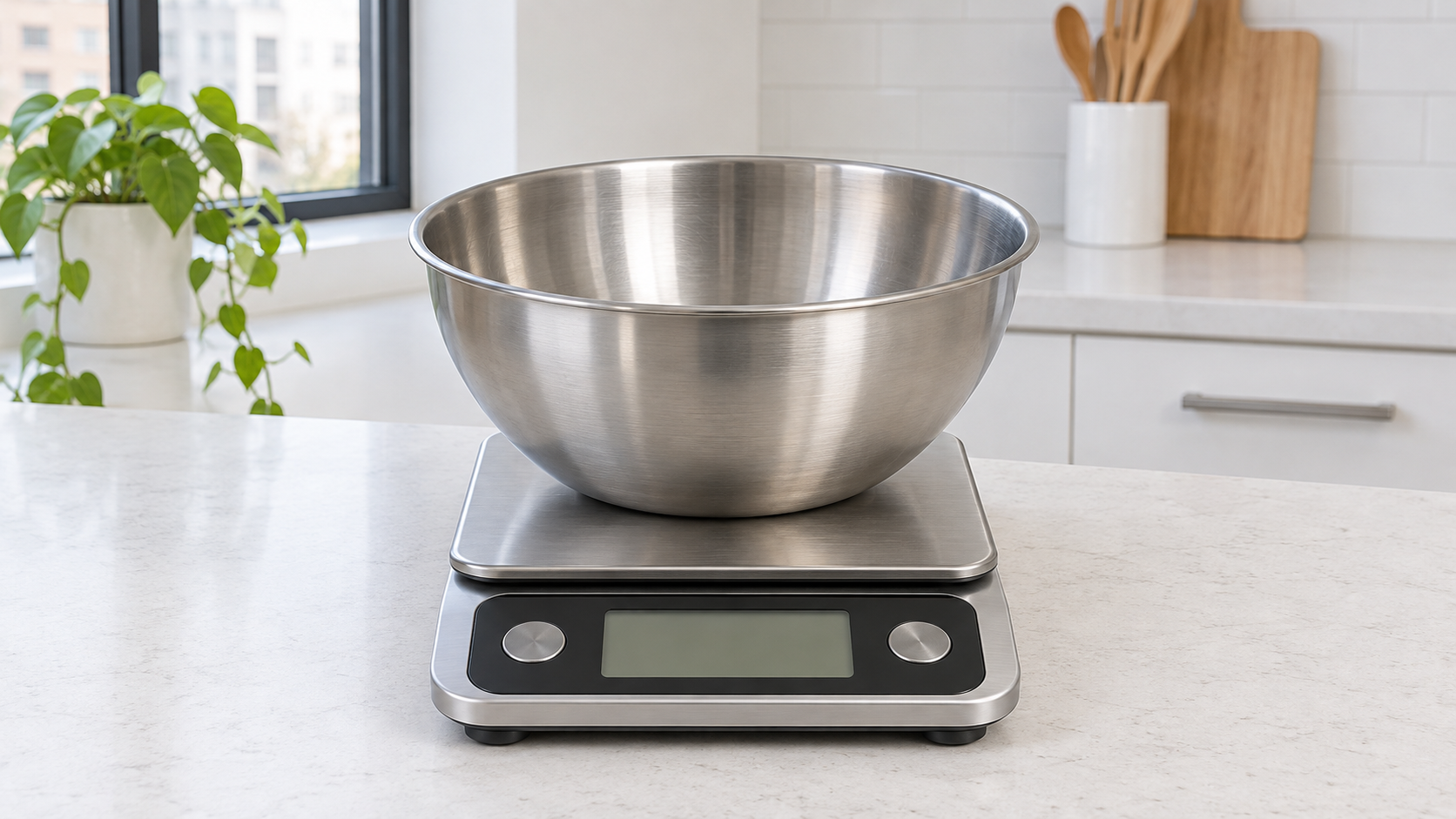
Food scale capacity vs tare comes down to this: tare lets a kitchen scale subtract the weight already on the platform. It does not add capacity. If a scale is rated for 11 pounds, placing a bowl on it and pressing zero leaves less of that 11-pound total available for ingredients, not more. Choose a scale by checking its stated maximum load, its zero or tare function, the size of the bowl you use, and the space needed to read the display.
Food scale capacity vs tare: zero is not extra load
The most common misunderstanding is treating the display’s zero as a new maximum. A tare function changes the displayed net weight; the platform and load sensor still carry the container plus the food. OXO’s 11 lb Stainless Steel Food Scale with Pull Out Display is a useful model-specific example: OXO states an 11-pound capacity, a zero function that tares before additional ingredients, and a meter that shows capacity remaining. The manufacturer describes those as separate features for good reason.
Read “capacity” as the combined load on the platform unless the exact maker says otherwise. That means a heavy mixing bowl, a baking stone, or a large pot can consume much of the rating before you add flour, water, or other ingredients. Never use the tare button as a reason to keep adding after a capacity indicator or error appears.
| Your recipe setup | What tare does | What capacity still includes | Better buying check |
|---|---|---|---|
| Light bowl plus ingredients | Shows ingredient weight after bowl is zeroed | Bowl and ingredients together | Confirm the maximum suits your largest batch |
| Several ingredients added in sequence | Lets you zero between additions | Every ingredient and the container | Choose a readable display and stable platform |
| Large plate or wide mixing bowl | May help display net weight | The plate/bowl still loads the scale | Look for a pull-out display or weigh in a smaller vessel |
| Bulk container placed on platform | Can show portions removed from zero | Full container remains part of the load | Avoid starting near the published limit |
Match the rating to the heaviest realistic setup
Make a short list of what will actually sit on the scale: the bowl or vessel, the largest ingredient amount, and any plate used for portioning. Add those as a planning total, then choose a product whose rated maximum clearly accommodates that setup. Do not infer a safety margin that the manufacturer did not publish. If you frequently weigh a full Dutch oven or an appliance insert, a standard compact food scale may not be the right tool.
Also consider display visibility. OXO’s listed pull-out display addresses the practical problem of a large bowl hiding the numbers, but it is a feature of that model, not a universal scale standard. If counter space is limited, decide where the scale will live and whether it can be pulled out without becoming a clutter magnet. Our renter kitchen cabinet organization guide can help create a dedicated home for small tools.
Use tare for cleaner recipe steps, not overload prevention
Tare is useful when you want to add ingredients one at a time to the same bowl. Put the empty bowl on the platform, use zero as the maker directs, add the first ingredient, then zero again if you need the next ingredient’s net weight. Watch for instability and keep liquids off the control area. The scale should sit on a hard, level surface rather than a soft mat or a crowded stovetop.
If you are portioning ingredients near the scale’s stated limit, divide the job into smaller batches. A second container or a measuring cup can be more accurate and less stressful than trying to work at the edge of a rating.
Know when a small food scale is not the right purchase
Skip a compact scale if your main job involves loads above the published rating, large cookware that covers every display position, or a workspace where it cannot remain dry and stable. For most small-kitchen users, the deciding factors are maximum combined load, a usable display, and storage access, not the number of units the scale offers.
Read the capacity claim the way the manufacturer presents it
Capacity may appear as pounds, kilograms, or both. Use the published figure for the exact model, not a similar model’s listing or a retailer’s short bullet list. If the maker provides a capacity indicator, it can help you see how much of the platform’s rated range is being used, but it does not change the limit. Remove weight when the scale indicates overload rather than repeatedly pressing zero.
Small changes in equipment can matter. A thin prep bowl and a heavy glass bowl create different starting loads. A large serving platter can also make the scale unstable or cover buttons and the display. Before choosing a scale online, measure the cabinet or drawer where it will live and the largest vessel you use, then read the product dimensions and instructions.
Build a sensible weighing workflow
Put the scale on a clean, hard counter. Turn it on and allow it to settle as the manual instructs. Place the empty bowl, tare it, and add one ingredient at a time. If you need to remove a portion from a container, use the method the scale maker describes and watch the combined platform load throughout. Clean spilled ingredients promptly without letting liquid reach the electronics.
For a large batch, divide the formula rather than trying to balance a full vessel near the maximum. This is practical for storage as well as capacity: two manageable containers are easier to cover, label, and refrigerate. If you are reorganizing the measuring area, this rental kitchen setup guide can help keep the scale, bowls, and measuring tools accessible without a cabinet overhaul.
Choose by the task, not by the display reading
A food scale is a useful tool for ingredients and portions, but its zero button does not make it a shipping scale, bathroom scale, or platform for cookware beyond its rating. Select a higher-capacity purpose-built scale when the task calls for it. The right purchase is one where the expected total load remains clearly within the maker’s published range.
Use a simple planning example
On an 11-pound-rated scale, a hypothetical 2-pound bowl leaves at most 9 pounds for all ingredients combined, including every prior addition, even after you tare the bowl. Treat that as a planning ceiling, not a target to test. If a recipe could approach it, divide the batch or use a scale rated for the expected total.
For storage, return the scale to a dry, protected shelf so the platform remains ready for the next measurement.
FAQ
Does pressing tare increase a scale’s maximum capacity?
No. Tare changes the display’s net reading; the container is still part of the platform load.
How much weight can the OXO 11 lb scale handle after I tare a bowl?
The bowl and ingredients together count toward OXO’s stated 11-pound capacity.
Why does my scale show an error after I zero it?
You may be at or over its limit, or the unit may need the manufacturer’s troubleshooting steps. Remove excess weight first.
Should I buy a larger scale for bread dough?
Compare your bowl plus your largest dough batch with the exact published capacity. Do not assume tare creates room.
Sources and fact-checking
Checked against the official sources below on November 27, 2026. This is research-based guidance, not a claim of hands-on product testing.



댓글 0
첫 댓글을 남겨보세요.